

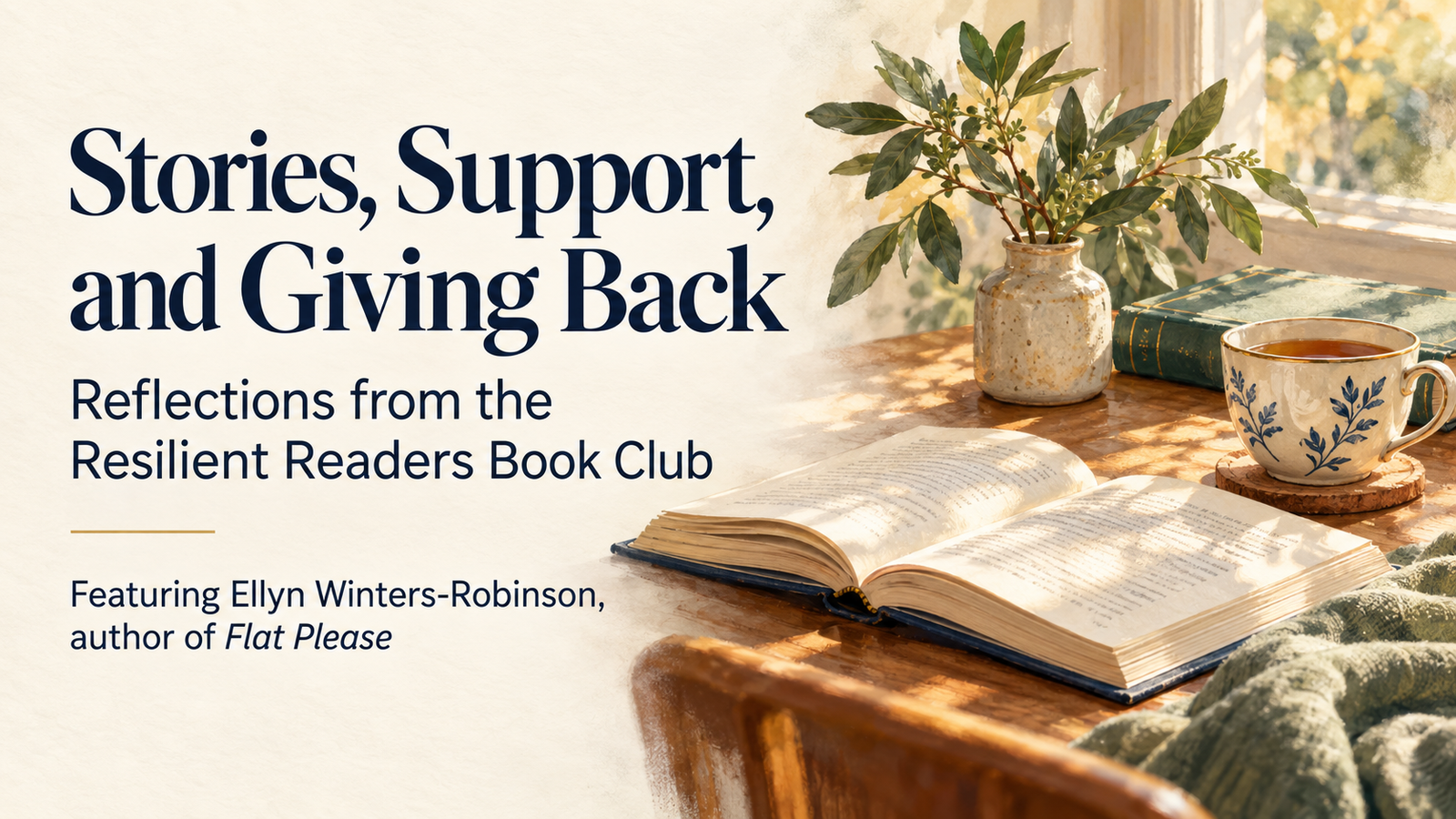
On October 5, 2026, I joined the Resilient Readers Book Club to hear Ellyn Winters-Robinson discuss her book, Flat Please: Hold the Shame, and AskEllyn, the AI companion she co-created for people affected by breast cancer.
The virtual club is presented by Texas Oncology Foundation and KickIt Recovery Wear. It meets every other month and welcomes patients, survivors, caregivers, and people who care for them. Cindy Trice, a cancer survivor and co-founder of KickIt Recovery Wear, moderates the conversations.
I’ve read several books about cancer, including Cancer Crossings, The Great Secret, The Song of the Cell, and The Emperor of All Maladies. They’ve helped me understand the disease through science, history, and other people’s experiences. I hadn’t read Flat Please yet, but I was curious to hear the story behind it.
Ellyn’s energy drew me in right away. She was candid about what she had been through, quick to find the humor, and generous with her answers.
Writing the book she wanted someone else to have
Ellyn spoke about her breast cancer diagnosis, her double mastectomy, and her decision to choose aesthetic flat closure rather than breast mound reconstruction. During chemotherapy, she arranged a photo shoot to reclaim a sense of agency over her body. Some of those photographs later appeared in People magazine.
She explained that she wrote Flat Please to share how those experiences felt. That included being frightened and bewildered, but also hopeful, amused, and sometimes caught off guard by the absurdity of everyday life during treatment.
One reader told her she brought the book to chemotherapy because it felt as though Ellyn were sitting beside her, holding her hand. That was the kind of companionship Ellyn had hoped to offer.
My experience with lymphoma is different from hers. I can’t speak to the decisions and experiences specific to breast cancer. Still, when she mentioned being four and a half years from diagnosis, I felt a connection. I’m also several years out, and I recognized her desire to use what she had learned to help someone else.
What do we do with what we’ve been through?
I asked Ellyn what helped her figure out how she wanted to give back, and how she made room for that while still taking care of herself.
She began by talking about a book on Stoicism that a friend gave her after her diagnosis. Two ideas had stayed with her: memento mori, a reminder that our lives are finite, and amor fati, often translated as a love of one’s fate.
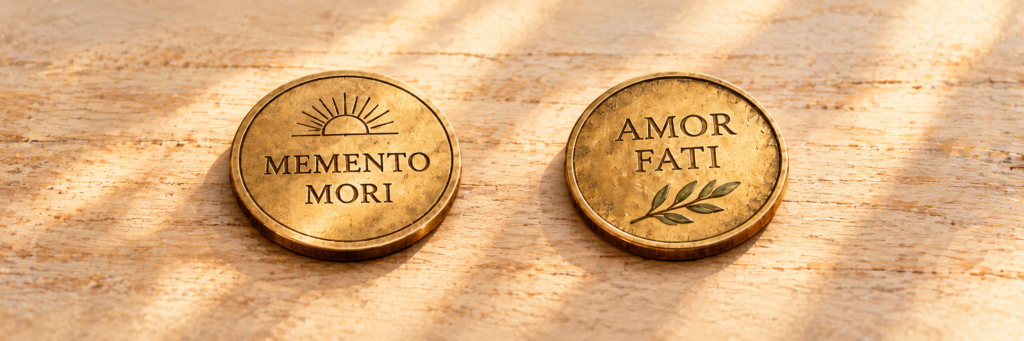
For Ellyn, amor fati meant approaching her experience with acceptance and curiosity. What could she do with what had happened? What might come next?
As she spoke, I reached for my own Memento Mori and Amor Fati coins. I had latched onto those ideas, too. It was an unexpected point of connection on a video call with someone I had just met.
She hadn’t mapped out everything that followed. Sharing her diagnosis led to conversations. Writing about her decision to go flat brought responses from people who felt understood. Her book eventually led to a collaboration that became AskEllyn.
“I just keep saying yes, keep showing up,” she said.
She acknowledged that the work can be difficult. Hearing from people it has helped keeps her going. One woman told her AskEllyn had supported her when she removed her bandages and saw her mastectomy scars for the first time.
Ellyn remembered how that moment had felt for her. Being able to offer some comfort to another woman, even through a digital companion, mattered to her.
That answer gave me a lot to think about. Giving back doesn’t always start with a plan. Sometimes you share something, discover that it helps, and decide to keep going.
A familiar voice, available when someone needs it
AskEllyn began with a question: could the personality and lived experience in Ellyn’s book become a conversational companion?
The result is a free AI tool intended to provide emotional support and information for people affected by breast cancer, including caregivers. It has a defined, non-medical role and is not intended to diagnose, prescribe, or replace a person’s care team. Ellyn explains its purpose here.
I’m interested in what tools like this can offer between appointments, when a question or worry comes up and someone wants a place to start talking.
My own desire to give back led me to work on Symptom Keep. Ellyn’s work serves a different need, but I recognized the motivation behind it. You remember something that was hard, and you try to make it easier for someone who comes after you.
Hearing her speak also reminded me to keep listening. Our own experience can give us a starting point. Other people’s experiences help us understand what they actually need.
The chocolate ice cream incident
Ellyn also read a chapter set shortly before she began chemotherapy. In the middle of the night, her husband fell down the stairs. She rushed to help him, saw what looked like blood on his shirt, and fainted.
The stains turned out to be chocolate ice cream from a late-night snack. His collarbone was broken, but the apparent blood had an entirely different explanation.
It’s hard to prepare for chemotherapy. It’s harder to prepare for chemotherapy while your designated support person injures himself and the evidence at the scene turns out to be Häagen-Dazs.
Ellyn told the story with affection and humor. Her husband, she said, had rolled his eyes when he learned which chapter she planned to read.
I appreciated that part of the evening. During cancer treatment, you’re still yourself, still part of a household where strange things happen and people occasionally make a mess of being helpful. Sometimes those are the stories you most want to tell afterward.
There’s relief in being able to laugh together without having to explain everything else.
I left grateful to Ellyn, Cindy, Texas Oncology Foundation, and KickIt Recovery Wear for bringing us together. I joined to hear about a book. I came away thinking about the ways we can use our stories, our skills, and whatever energy we have to help another person feel less alone.
Find Ellyn’s book, Flat Please: Hold the Shame, learn more at AskEllyn.ai, or try the AI companion.
For future discussions, visit the Resilient Readers Book Club, presented by Texas Oncology Foundation and KickIt Recovery Wear.
Leave a Reply