


I had completed my last treatment.
The effects of chemo and lumbar punctures were still visible every time I looked in the mirror. My body felt fragile and weak in ways I had never experienced before. My heart rate was permanently elevated. Walking to the mailbox, not even a block away, left me sweating and out of breath. I felt like crepe paper; thin, easily torn, unable to hold much weight.
But I had finished.
In my mind, cancer had been a finite problem with a finite solution. Six rounds of R-CHOP. Four lumbar punctures. Get through those, and I would be done with this chapter. My lymphoma had been caught early. I had been healthy before the diagnosis. I told myself that once treatment ended, life would simply resume, maybe slower, maybe humbler, but essentially intact.
That belief carried me into my final PET scan.
The tumor had been growing high in my sinuses, near my pituitary gland, for who knows how long. The lumbar punctures (spinal taps) were precautionary. Doctors were concerned about the risk of spread into my spinal cord, where the consequences could have been catastrophic. In certain high-risk lymphomas involving the sinuses, prophylactic treatment is sometimes used to reduce the risk of central nervous system involvement—a complication that can carry severe, irreversible consequences.¹ Losing mobility. Losing independence. Losing parts of myself I took for granted.
I survived all of that, so when I walked into what I thought was my final oncology visit, the mood was light.
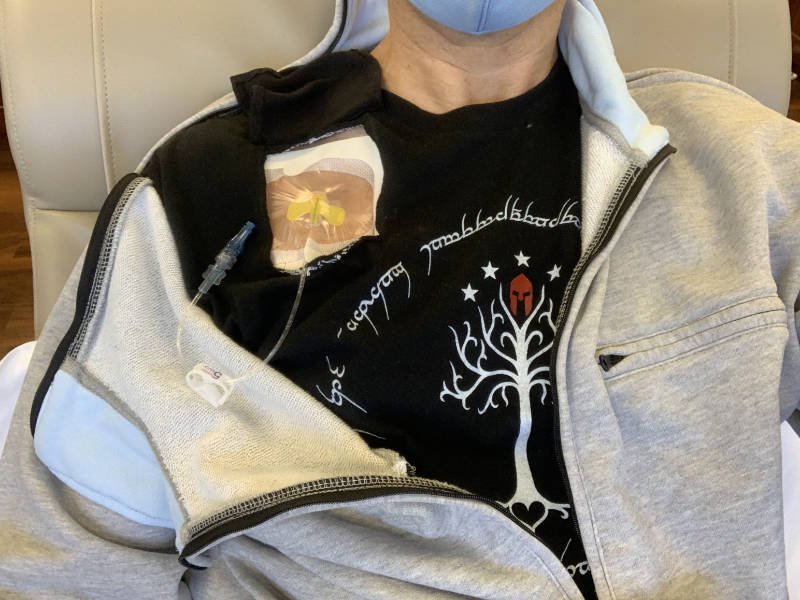
We joked about my homemade “port shirt,” a t-shirt my mom helped me modify with a flap in the front so nurses could access my port more easily. We laughed about the fact that I had sacrificed a Lord of the Rings shirt to do it. I made a “You shall not pass” joke. It felt like a moment of release. A closing scene.
Then my oncologist looked at the scan.
“From these images,” he said carefully, “it looks like there’s still some cell activity.”
The air left the room.
I remember asking what that meant, but I don’t remember the exact words. He explained that it could mean the remaining cancer cells were still dying. Or it could mean something else. There was no certainty yet. He wanted to schedule another PET scan in a month and see how things progressed.
I nodded. I listened. I tried to hold myself together.
But inside, something fundamental cracked.
My mental model of “being done” collapsed in that moment. I had assumed the hardest part was enduring treatment. I had not prepared myself for the possibility that treatment might not be enough—or that certainty itself was no longer on the table.
This is what cancer teaches you, whether you want the lesson or not.
The fear isn’t just the diagnosis. It’s the possibility of return. The idea that even when you’ve done everything right—followed the plan, endured the pain, crossed every milestone—there may still be unfinished business happening inside your body.
I was reminded of something my ENT had said early on, almost casually, when delivering the diagnosis:
“It’s treatable.”
Not curable. Not temporary. Treatable.
At the time, I didn’t fully understand the weight of that word. I had never lived with a chronic illness before. I didn’t yet grasp that “treatable” can mean ongoing. It can mean managed. It can mean watched closely, indefinitely.
I left that appointment shaken. I talked to friends. To colleagues. To anyone who would listen. One thoughtful colleague suggested getting a second opinion. I did.
There was still more ahead: a month of daily radiation. Annual PET scans. First three, then six, then 12 months apart. Regular oncology visits. Persistent heart issues that would linger long after the cancer itself was under control and in remission.
This wasn’t a sprint I could power through. It was a long game. One I hadn’t known I was signing up for.
And that’s when something shifted.
Not toward optimism. Not toward despair. But toward vigilance.
Vigilance is different from fear. It’s quieter. More disciplined. It’s the decision to stay attentive without letting the anxiety consume you. To notice patterns. To remember details. To take your body seriously, even when others are ready to move on.
After the last treatment, the world often expects closure. Survivors are congratulated. Some ring a bell. Life is supposed to “go back to normal.”
But for many of us, what follows isn’t an ending—it’s a watchful middle.
That space after treatment & before certainty is where Symptom Keep was born.
Not as a cure. Not as a promise. But as a way to support vigilance without obsession. A place to notice changes, record what matters, and maintain agency in a system that often moves on faster than patients are ready for.
If you’ve been here. If you’ve felt that disorienting moment when the finish line dissolved beneath your feet, you’re not alone.
The work doesn’t end when treatment does.
Sometimes, what comes next is learning how to live attentively, carefully, and honestly with eyes wide open.
That’s vigilance. And for many of us, it’s the most realistic form of hope we have.
___________
¹ NCCN Guidelines for Patients: B-Cell Lymphomas (Diffuse Large B-Cell Lymphoma)
“A lumbar puncture may also be used to inject cancer drugs into spinal fluid. This is called intrathecal (IT) chemotherapy. When systemic therapy and IT therapy are given together to prevent CNS disease, it is called CNS prophylaxis.”
— NCCN Guidelines®, Diffuse Large B-Cell Lymphoma, Version 2025
Leave a Reply